
Search "how to tell if honey is real" and you'll find the same handful of kitchen tests repeated on almost every site: drop it in water, try to light it, watch how it drips off your thumb. They're everywhere because they're easy to demonstrate — not because they're accurate. Here's what actually holds up, and what to rely on instead.
The tests you've probably heard of
The water test. The claim: pure honey sinks and holds together in a glass of water, while fake honey dissolves quickly. In reality, how fast honey dissolves depends mainly on its moisture content, temperature, and how hard you stir — not on whether it's pure. Some genuine, single-origin honeys dissolve quite fast; some corn syrup blends are thickened enough to sink slowly. It's testing viscosity, not authenticity.
The flame or matchstick test. The claim: dip a matchstick in honey and it should light easily if the honey is pure, since water content stops it from burning. This one mostly tests moisture, and moisture varies naturally between honey types and harvest seasons — a genuine wild honey harvested in humid weather can have enough natural moisture to fail this test, while a dehydrated fake syrup can pass it easily.
The thumb test. The claim: a drop of pure honey stays put on your thumb instead of spreading. Again, this measures thickness, and thickness differs a lot between naturally thin honeys (like some wildflower varieties) and naturally thick ones — neither is more or less "real."
None of these three are junk science by accident — they each latch onto something real about honey's physical properties (density, moisture, viscosity). The problem is that none of those properties is unique to pure honey. Adulterated honey can be formulated to mimic all three.
What crystallization actually tells you
Crystallization is a genuinely useful — if imperfect — clue. Raw, unfiltered honey crystallizes naturally over time as glucose separates out; it's a sign of minimal processing, not spoilage. Commercial honey is often heated and micro-filtered specifically to delay this, so a jar that never crystallizes has usually been processed. That said, it's not proof either way: a few pure varieties (acacia honey, for instance) resist crystallizing for a long time by nature, so its absence alone doesn't mean a honey is fake — just that crystallization is a point in favour of raw honey, not a pass/fail test.
So what actually works?
The only methods that reliably detect adulteration are laboratory ones — tests like NMR (nuclear magnetic resonance) spectroscopy, isotope analysis, and pollen analysis, which can detect added sugars at a molecular level. None of that is something you can do standing in your kitchen.
For everyday shopping, that means the honest answer isn't a trick — it's traceability. Look for:
- A single ingredient. The label should say "honey." Nothing else.
- A traceable source. Brands that can tell you which region, season, and harvester your jar came from are much harder to fake than anonymous bulk honey.
- Small-batch harvesting. Large-scale blending is where adulteration typically enters the supply chain — mixing batches (or stretching them with syrup) is easy to hide at volume, much harder in a small batch you can trace start to finish.
That's the actual reasoning behind how we source our Wild Flora Honey: it's hand-collected by one honey hunter across the Sutlej belt, and only mature, capped honeycomb is harvested — nothing blended in, nothing watered down, and nothing that needs a kitchen test to prove it.
How to store raw honey once you have it
Raw honey keeps well for a long time if you treat it right:
- Room temperature, out of direct sunlight — no refrigeration needed.
- Keep the lid tightly sealed between uses; honey absorbs moisture and odours from the air.
- If it crystallizes, that's normal — stand the jar in warm (not boiling) water until it turns liquid again. Avoid the microwave, which heats unevenly and can damage the natural enzymes raw honey is valued for.
The bottom line
The water, flame, and thumb tests feel scientific, but they're testing the wrong thing. Crystallization is a genuine (if partial) clue. Everything else comes down to trusting where your honey actually came from — which is a sourcing question, not a kitchen experiment.
More from the Purity Guide
All articles →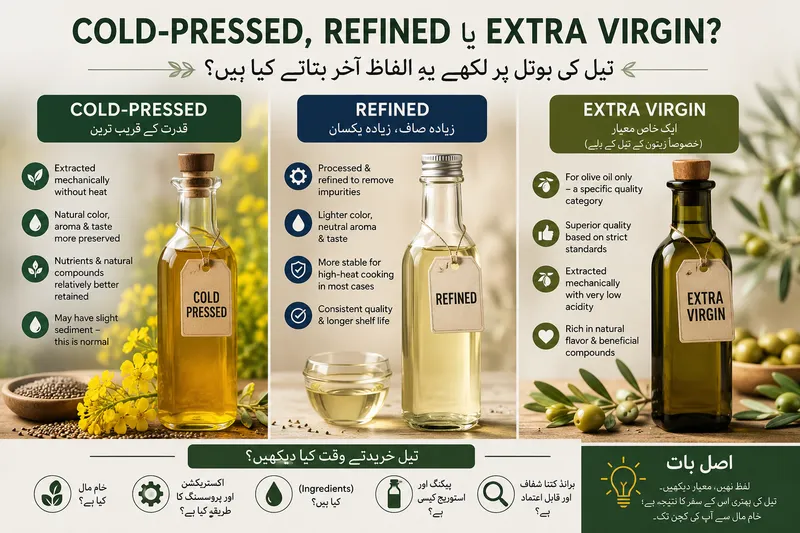
Cold Pressed vs Refined vs Extra Virgin
Cold-pressed, refined, extra virgin — the labels on oil bottles all sound premium. Here is what each term actually means, and which is right for your kitchen.
Read Article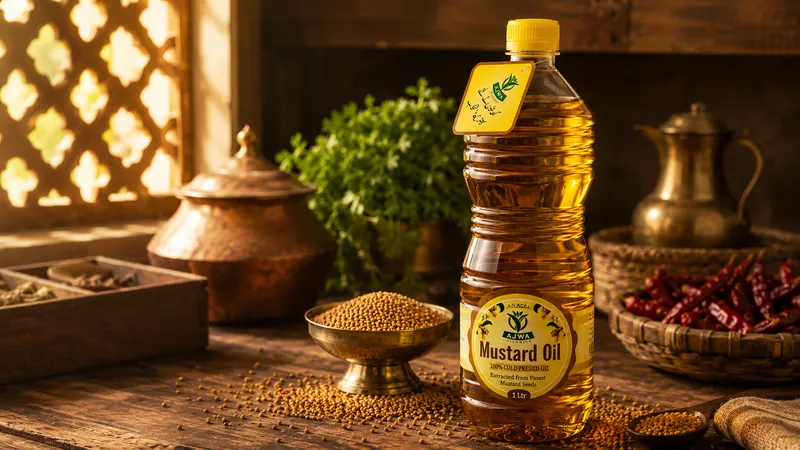
سرسوں کا کولڈ پریسڈ تیل: کیا یہ آج بھی آپ کے کچن کے لیے ایک اچھا انتخاب ہے؟
سرسوں کا کولڈ پریسڈ تیل ذائقے، ہائی اسموک پوائنٹ اور ALA اومیگا-3 کی وجہ سے آج بھی ایک بہترین کوکنگ آئل ہے، بشرطیکہ اس کا معیار اور خالص پن قابلِ اعتماد ہو۔
Read Article